
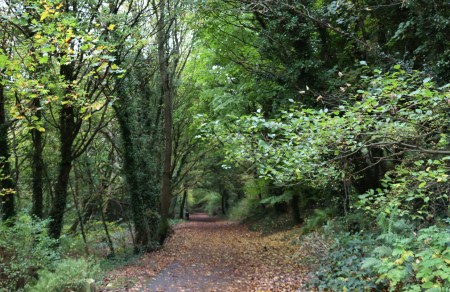
 On visit to Basingwerk Abbey a few months ago, we noticed signage indicating that the abbey was at the south end of the Greenfield Valley Park, the north end of which is Holywell just to the south of Holywell town centre. The Greenfield Valley Park had been on my to-do list for ages, but it was my friend Katie’s suggestion that we go today, and she brought David Berry’s guide book with her, which included a map that we followed to make the most of the park (details below).

Map from Greenfield Valley Visitor Centre
The park, which includes the ruined abbey and St Winifred / Winefrede’s Well follows both the line of the Holywell Stream that erupts in bubbles at St Winifred’s Well, as well as the line of a former railway track that ran from Holywell to Greenfield Dock. It is one and a half miles as the crow flies from north to south, but covers 70 acres and consists of a network of metalled paths (marked on the map) and tracks, beautifully maintained, connecting some remarkably preserved industrial heritage. Each one of these buildings was accompanied by large tracts of water that were used to power water wheels that were built in the late 18th century and continued to be used well into the 19th century.
As well as being fascinating, the tree-filled park is a lovely place to walk, particularly appealing in its multi-coloured autumnal garb. In the summer there are birds and butterflies, and even at this time of year there was the occasional woodland flower. There is also the little Bakehouse café in Basingwerk House at the south end of the park, next to Basingwerk Abbey, which serves good coffee, cake and a small, imaginative menu of nicely presented and very enjoyable food.
This post is confined to the really gripping industrial heritage. I’ll talk about Basingwerk Abbey on another post, and St Winifred’s well, both of which we visited on the same day, will also be dealt with separately. The following highlights of the walk start in the north and head south ending at Greenfield Dock. The numbers in the text refer to the map above.
sdafasdfas
The Holywell Rail Line and bridge
 The wide metalled footpath that links Holywell in the north with the A548 to the south follows the line of a standard gauge railway built in 1868. Its purpose was to carry minerals from the Greenfield Wharf, now known as Greenfield Dock, and to ship products made at Greenfield Valley to Liverpool for sending further afield. In 1912 it was converted to carry passengers, and became known as the Little Train. It claims to have been the steepest conventional passenger railway line in Britain, with a 1:27 gradient. At the top of the path, near Holywell, there is a massively constructed railway bridge (10) with two wide arches. Today, charmingly, it is a footpath, leading from Tesco to a housing estate.
asfasdfsd
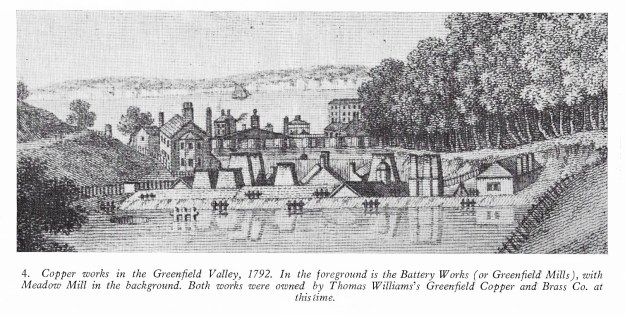
Greenfield Valley 1792. Source: Davies and Williams 1986
Battery Works
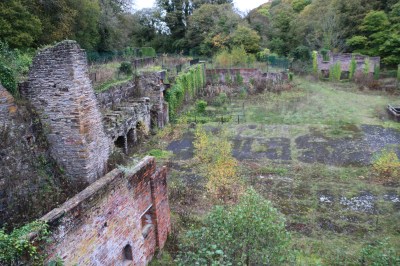 Established in 1776, the Battery Works (8), also known as Greenfield Mills, was built to manufacture pots and pans from brass sheets. Davies and Williams describe the process (p.28-9): Each of the four copper and brass battery mills “consisted of large hammers raised by a cog on a rotating beam. The beam extended from the axle of the waterwheel so that each waterwheel worked up to six hammers. Once the cog had passed, the hammer fell, striking an anvil. Workmen would hold sheets of plates of metal on the anvils and as the hammer hit them, shape them into pans, bowls and other articles.”
fdfdsfsd
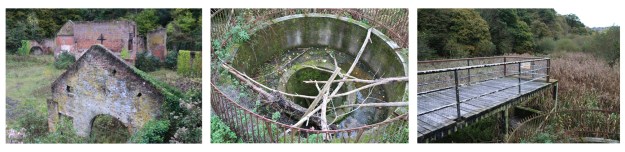
 The troughs that held the water to turn the wheels can still be seen. One of the pits where the waterwheel turned can still be seen in the photograph below, together with a section of wall with a circular hole where the wheel once turned. Like all the main industrial operations along the river, it was backed with a large body of water at its northern (upriver) side. The water is now full of bull rushes. Even though it is impossible, just by looking at the ruined remains, to see exactly how all the different elements fitted together, this is a massively impressive piece of the Greenfield site. The finished products were shipped to Africa via Liverpool and exchanged for West African slaves.

Meadow Mill
 In 1787, eleven years after the Battery Works, a new mill (7) was built by the Greenfield Copper and Brass Company to produce rolled copper sheets, and to make copper rollers for printing patterns on to cloth. The main building was a sizeable affair, 86 x 69ft (26 x 21m), with two pillars 11.5ft (3.5m) apart supporting a roof made of copper sheet. It was fitted with three cast iron wheels, each 20ft (6m) in diameter. Copper ingots were melted and moulded into plates 3 (0.9m) x 4ft (1.2m) and about 1/2 inch (1.27cm) thick, which were cut into strips, that were in turn fed between pairs of rollers to create sheets of various thicknesses. These could be turned into wire or other products. When this work came to a close, the site was used by a number of other smaller-scale industries, including a tin plate works.

Meadow Mill is backed by a basin of water that fed the water wheel that powered the mill. It is now marshy and full of algae, making life rather interesting for the moorhens, and the surrounding foliage is now home to several species of butterfly. On the other side of the water wheel, the water was taken down to the next level of the valley down a purpose-built run-off.

In the 1850s it was taken over by Newton Keates as a lead works. This was followed by a tinplate works, then a brass rolling and wire works, and in 1890 was leased to William Eyre for rubber grinding and processing.
Lower Cotton Mill
 There were a number of cotton mills along the Greenfield Valley, built for the manufacture of cotton textiles, all water-powered, in a period when cotton was one of Britain’s primary exports. John Smalley, one of the backers of Richard’s Arkwright’s ground-breaking spinning frame, established a mill with his colleague John Chambers. Their company was the Cotton Twist Company. The earliest mill was built from stones taken from the nearby Basingwerk Abbey, and was called the Yellow Mill. The business was declared bankrupt in 1780 and Smalley died in 1782, but Smalley’s window Elizabeth was able to find partners to push the business forward, and the business went from strength to strength. Upper Mill was built inn 1983, Lower Mill (6) In 1785 (in just 10 weeks) and Crescent Mill in 1790. All were fitted with Arkwright’s spinning frames and were worked by many local people, including young children. The six-storey mill that survives today is the Lower Cotton Mill, its spinning frame once powered by a waterwheel 18ft high (5.5m) and 7ft (2.1m) wide with a 16ft (4.8m) fall of water. You can see the culverts that were built to carry the water beneath the buildings and feed them further down the valley.
 From where we were walking, on the upper path, we could look down into the ruined warehouse’s, which was impressive. In the 1850s it was taken over by a flour merchang and renamed the Victorian Corn Mill; the water basin is still called the Flour Mill Pond. Later it was the premises of a wheelwright and a brickworks.
If you were on the lower path, one of the buildings (which we did not know about) has apparently been restored and now houses a steam bottling plant, a railway museum and an exhibition on the industries of the Valley. It was something of an omission that we missed this! A good excuse to go back. At the time of writing, admission is free.
Abbey Wire Mill

The Abbey Wire Mill overshot waterwheel in pit. Source: Chris Allen, Geograph
The site of the former copper and brass wire factory (5), the main output of which was pins and bolts, has little to see. It originally covered about an acre, and was the site of the wire mills of the Parys Mine Company, where rods of copper and brass were pulled through a series of holdes of decreasing size and then heated and cooled until wire was produced. The site does contain an original waterwheel pit in which a waterwheel is still located, now renovated and capable of producing electricity for the museum.

In 1856, Newton Keates and Co leased the site and raised the level of the dam to create a larger pool. This was a mistake. Water broke through and flooded in 1857 and 1858, so the height of the water behind the dam had to be lowered. The works closed in 1894 and the machinery was auctioned off.
Apparently, at a later date in the early 20th century, a small soap-works was built on the site which produced, presumably amongst other themes, soap imprinted with images of St Winifred, the first batch of which were sent to the Pope. The mind boggles. Today there is a small bandstand at its edge.
Further down the path, and the Bakehouse Café is located in Basingwerk House, a fine 1930s building. We had a very good lunch there. Beyond that is Basingwerk Abbey (about which more on another post) and beyond that is a car park and the A458, which you need to cross to reach Greenfield Dock, which is off the above map.
Greenfield Dock
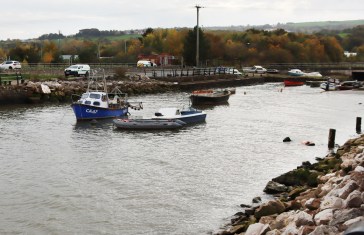 Greenfield Dock is beyond the Green Valley Park, but is only a short walk away, reached by going through the car park beneath the abbey, crossing the main road, heading left for a short distance and taking the first on the right. This is Dock Lane, which takes you to Greenfield Dock and the Wales Coast Path. There’s not a lot to see, just a couple of tiny fishing boats in an inlet, and views (on a less grey day) across to the Wirral, but the dock was an important contributor to the Green Valley industries, linking with the Holywell Rail Line.
 The Wales Coast Path, however, looks excellent in both directions, and a great destination for a sunny day. It starts in Chester, and can be followed continuously around the entire Welsh coastline, but can be done in short chunks. From here, for example, one could head upriver to Flint along the Path, and visit Flint Castle (which I have written about here), which is a walk of 4.3 miles (6.9 km) from Greenfield Dock to Flint Castle, but don’t forget the return journey.
——-

Wales Coast Path: Flint to Holywell. Source: Wales Coast Path
Visitor Information:
This is an excellent place to visit, with stacks to see. If you are interested in industrial archaeology, wildlife on land and water, and woodland walks, you will not be disappointed.
 To give some idea of how long it took us, we started out from Churton (about 15 minutes drive south of Chester) at 1030, arriving in Holywell at about 1115, having taken the most direct route along the A55, and we left at 1530, with a short stop for coffee and a snack in the park. This is a dry-day walk, because there is nowhere to shelter.
In the Greenfield Valley everything is open and free to see other than the Green Valley Park Museum and St Winifred’s Well and Chapel. We didn’t visit the museum, which is behind the visitor centre but details are available here. Details for St Winifred’s Well can be found here. The museum and visitor centre are closed from the end of October onwards. There are also details about children’s activities on the Greenland Valley website here.
From a mobility point of view, a number of tracks, including the one that follows the line of the old railway are wide and metalled, but there is a distinct downhill gradient from Holywell to the abbey, and of course there’s the uphill gradient on the return journey.
Sources:
Berry, David, 2012. Walks around Chester and the Dee Estuary. Kittiwake Books
Davies, K. and Williams, C.J., 1986. The Greenfield Valley. An Introduction to the History and Industrial Archaeology of the Greenfield Valley, Holywell, North Wales. Holywell Town Centre
Greenfield Valley visitor’s Guide and Map (A3 fold-out)
The Industrial Heritage of Greenfield Valley. KS2 and KS3 Teaching Resource
cadw.gov.wales/sites/default/files/2022-02/Industrial%20Heritage%20-%20Greenfield%20valley%20resource%20-%20English.pdf
Greenfield Valley Park: www.greenfieldvalley.com

 Based in Churton