

The Pump House
What a brilliant place! The Lion Salt Works in Northwich is not only the last open-pan salt works in Cheshire but one of only four remaining in the world. I had really very little idea of what to expect, but of all the places I have visited, this one most resembles an industrial time capsule. It is as though things were left just as they were when the Works closed, which is more or less what happened. The biggest market for Lion Works salt was West Africa, but when the Nigerian Civil War broke out in the late 1960s, and the political situation that followed it failed to improve matters, the Lion Salt Works struggled to survive, and the business closed in 1986. The decision was made to convert the Works into a museum of salt working, and what a good decision that was. There are lots of information boards, models and sound effects, all excellent, but what really grips is the sense that this could all start up again tomorrow.

Roman and Medieval salt pans
Another extraordinary aspect to the place is how for just under a century, between 1894 and 1986, the method of making salt from brine hardly changed. In fact, the method used was pretty much the same as that employed by the Romans in the same area. Open-pan salt manufacturing is just what it says – the salt-carrying water, brine, was pumped up from two levels of rock-bearing beds from below the surface and then fed into huge rectangular iron pans, which were heated from below to drive off the water, and then dragged to the side of the pan to help them drain

Salt beds beneath the Lion Salt Works
The Cheshire salt was once suspended in sea water. In the Triassic Period, c.220 million years go, the Cheshire Basin was a tropical lagoon in which seawater became trapped. As the water evaporated from the lagoon, it left behind a rock salt known as halite (Sodium Chloride). Two bands of of salt lie under Northwich and were tapped by the Lion Salt Works. The first is 40m (131ft) down and is 20m thick (65ft), then there is a 10m (33ft) layer of marlstone and then a second, 30m (90ft) layer of salt. When rainfall entered the water table and washed over the salt layers, it dissolved the salt again, and created subterranean streams of highly salted water known as brine. Natural forces pushed these salty streams to the surface in the form of natural springs, but the streams themselves could be tapped by drilling down to them and pumping the brine out at the pump house.
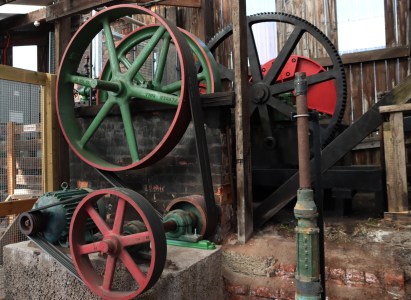
Inside the Pump House
The pump house is a good place to start your visit on the way from the car park to buy your ticket in the former Stove House, now containing a brightly modern shop and café. The brine, once extracted from the borehole, was stored first in a tank and from there it was distributed to the salt pans for processing. A steam engine powered the pump, and both the engine and its boiler are still visible in the pump house. The pump was known as the “nodding donkey” due to the motion of the overhead beam as it rose and fell.

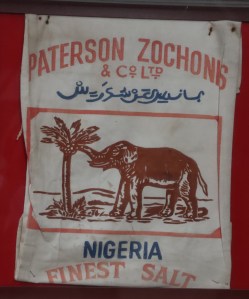 Once beyond the ticket office, you follow the signs to enjoy a self-guided tour. There are plenty of disabled elevators for the leg-challenged and for wheelchair users, which you can operate yourself.
The first building that you come to is a former terraced house, the Red Lion Inn. The original Red Lion Hotel was knocked down in order to expand the mining operation, so two terraced houses were purchased in order to give the workers somewhere to relax after the heavy labour in the stove and pan houses. This building is now used to show Roman and Medieval versions of the pans (just smaller, not actually any different in how they were used) and to show a reconstruction of the works office, complete with clocking-in machine, and the Red Lion bar.

Indoor salt pan on the first floor
It is difficult to get one’s head around the salt pans. The concept is childishly simple, but the sheer hands-on labour involved even as late as the 1980s is truly remarkable. There are displays showing the role of each of the workers. The Lion Works was set up and run by six generations of the Thompson family, and the workers were all local people. At first both men and women were employed in the heavy duty work of the Works, but later women were confined to the less strenuous work of packing up the salt and carrying out administrative tasks.
The two main initial tasks were to rake up the salt in the pans once the water had been evaporated off (creating steam-heavy rooms), and to feed the fires in the stove houses. Here’s a somewhat eye-popping excerpt from the guide book:
Salt-making was a ‘dark art’ and the salt workers would add all sorts of things to make the salt crystals form. These included strong ale, bullock’s blood and eggs, but these were replaced by soft soap and glue

First floor stove room
Workers known as wallers worked in the outdoor pans, pulling the salt along the edges of the pan to form large walls to drain it. Inside, lumpers worked on smaller (but still huge) pans to rake the salt to the sides where it drained, before pacing it into blocks or lumps. The lumps were taken on barrows to the stove rooms to dry out. From here they went through a crushing mill, a splendid piece machinery that was steam-powered until the 1950s when it was converted to electricity. The resulting salt grains were graded from fine to coarse before being packed up in bags or small plastic packs.
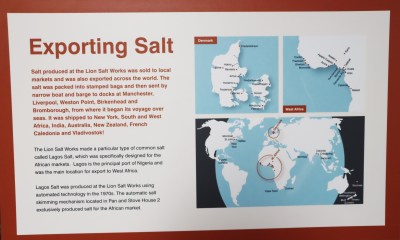 The salt that was processed outside was inferior to that made inside, not due to the original brine or the work of the crushing machine, but due to the temperature at which it was heated in the pans. This is because of the multiple uses of salt, from fine-dining to packing fish caught at sea. The Trent and Mersey Canal runs alongside the works. Coal to power the engines and to heat the pans was delivered by narrowboat and the packaged salt was also sent out by narrowboat. The canal network was huge, and even though canal travel was slow compared to the railways that eventually replaced them, was well equipped for transporting heavy, bulk products reliably to towns, cities and ports.
 The mining works had a dramatic knock-on effect on the structural stability of the town of Northwich. The story of the subsidence caused by the mining is another aspect to the story that is truly compelling. On the approach to the Lion Works, one of the mines subsided so thoroughly in 1928 that two flashes now flank the road. The subsidence had a truly transformative impact on buildings and infrastructure, and not in a good way. Buildings shifted, some tilting backwards or forwards, others dividing slowly into two, the brickwork forming great fissures as the subsiding and pulled them in opposite directions. The solution was to go back to Medieval domestic building traditions, creating light-weight frames and building in jacks points into which levers could be inserted, in order to persuade buildings back into position. Other buildings, like the Bridge Inn, could simply be moved in their entirety. This gives the town today a half-timbered look. It is an astonishing idea that to respond to the conditions, buildings became just as shiftable as furniture. Roads too subsided, and one collapse caused a major breach in the neighbouring canal.
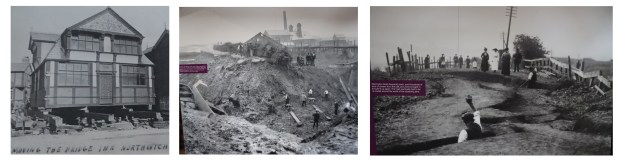
Left: The Bridge Inn in Northwich on the move, giving new meaning to nomadic settlement strategies. Middle: The Marston Hall mine collapse caused part of the canal to subside in 1907. Right: Warrington Road frequently sank and 1000s of tons of salt pan cinders were used to build it up again.
There is lots more to find out at the museum, and I recommend it for anyone interested in industrial heritage. As well as the Works themselves, there are plenty of really excellent information boards, some interactive displays aimed mainly at children, and some absolutely splendid photographs.
Visiting
 We piled out to Northwich along the M56, and it was easy to find the Lion Alt Works by leaving at Junction 10, but we had intended to return via the A51, taking in the Anderton Boat Lift on our way back. In our dreams. At the time of writing (September 2022) Northwich is up in extensive roadworks, and the diversion signs must lead somewhere, but heaven knows where. A sign half-buried in an overgrown verge directed wannabe Boat Lift visitors to follow the diversion signs, which was hysterically funny as the diversion signs were, as stated,completely unfathomable. We just about found our way to the A51 to Chester (although not by following the diversion signs), but we never did find the Boat Lift, in spite of several attempts, both with and without the SatNav.
At the museum there is a car park, café and shop. A free map is given out, but a really useful guide is available for purchase too. The opening times on the website state that the museum is closed on Mondays except bank holidays, and there is an entrance fee. For up to date information check out their website.
https://lionsaltworks.westcheshiremuseums.co.uk/
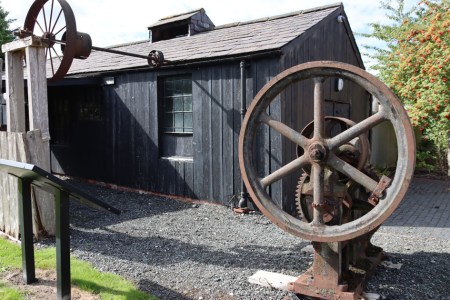
The smithy
The staff at the museum were friendly and helpful. We were chatting to one of them at the end of our visit when we were sitting in the café. His knowledge was immense, and he knew the answers to all the questions that we fired at him. I failed to catch his name, but my sincere thanks.
The coffee came from a push-button machine, but was absolutely fine, and the tea was served in a lovely little pot. The coffee was a particularly nice surprise after the undrinkable swill that was being served with breakfast in the Novotel in Greenwich (London), where I was staying recently!
For disabled and mobility-challenged visitors, there are wheel-chair friendly lifts to the upper floors, and you can operate these yourself. The whole museum is intended to be disabled friendly, and at least to my eyes, looked very well thought out.

Feeding the ovens beneath salt pan 3
I wanted to see if there was any edible (as opposed to ornamental) local salt for sale, but forgot. I am real salt enthusiast and always have several types at home for both cooking and seasoning at the table, so I am a tad miffed that I forgot to look! If you go, do let me know if they were selling any. There were blocks of ornamental salt for sale, in beautiful shades of pink, but I have no idea if it was edible too.

Manager’s house
Northwich town itself looks as though it will be well worth visiting after all the roadworks have come to a close, particularly if you are a fan of inland waterways and the architecture and civil engineering that goes with them (which I am). Make sure that the Anderton Boat Lift is open if you want to see it, as its opening times seem to be something of a movable feast.
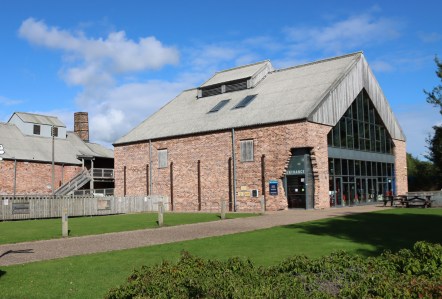


The crushing mill

Interior of the smithy


 Based in Churton
I think you are unfair to the Diversion signs at the Anderton Boat Lift. Conscientiously following them brings you round in a perfect circle to where you started off. You are allowed to do this as often as you like, and the local countryside is very pretty. WB.
LikeLike
Hi Andie, another very interesting and informative post. Mike Nevell did quite a bit of work on the salt industry in Cheshire and led some digs in Northwich. https://www.academia.edu › Brine_i…
(PDF) Brine in Britannia: Recent Archaeological Work on the Roman Salt Industry in Cheshire | Michael Nevell and Andrew Fielding – Academia.edu
He leads on industrial archaeology and is now based at Ironbridge but still has contact with South Trafford Archaeological Group who I used to go digging with.
LikeLike
Thanks so much for this – I am looking forward to reading those papers.
LikeLike