

Image source: Tŷ Pawb website, with original image © Amgueddfa Cymru (National Museum Wales). The giraffe is sublime, but the panther is bliss.

The Tailor’s Quilt, by James Williams. Click to see the larger, clearer image. Image source: Tŷ Pawb website, with original image © Amgueddfa Cymru (National Museum Wales).
The Tailor’s Tale exhibition, at the Tŷ Pawb gallery in Wrexham, is on until September 24th 2022. It is a rare opportunity to see the mid-19th century “Tailor’s Quilt” without having to go to south Wales to see it in its usual home. The exhibition is showing at the same time as the exhibition Blanket Coverage, in the same gallery, about which I have already written here.
The Tailor’s Quilt was made by master military tailor James Williams of Wrexham (c.1818 – 1895). It is on loan from the St Fagan’s National Museum of History in Cardiff. The museum bought it in 1935 from Williams’s grandson during the economic depression, where it joined a national folk art collection, which now has over 200 examples of Welsh quilting and patchworks.
As well as the quilt itself, which is a complete joy, the exhibition features modern art works, including designer clothing and accessories by Sarah Burton (fashion house Alexander McQueen) and fashion designer Adam Jones; a range of items by Mark Herald, based on the quilt and commissioned by Tate Britain; and a set of four small pieces by Quilter’s Guild of the British Isles members Judy Fairless, Anne Gosling, Barbara Harrison and Helen Lloyd. It is one of the pleasures of The Tailor’s Tale, that 19th and 21st century approaches to patchwork and quilting by local textile specialists can be seen side by side, with all the implications of social and economic change that each implies.
afdasfsd
The Tailor’s Quilt
First, a bit of terminology. A quilt is generally defined as at least two layers of fabric with padding, called wadding, between them, all stitched together either with straight lines crossing each other to form squares or diamonds, or in more elaborate designs. A patchwork consists of pieces of fabric sewn together. A patchwork quilt is a patchwork that has been provided with a wadding and backing, and has been sewn together at multiple places across the surface to connect all three levels, to form a patchwork quilt. The Tailor’s Quilt, technically, is a patchwork, because it is made up of different fabrics sewn together but is not sewn over to join all the layers together. It is made using the intarsia method, as described by Dr Clare Rose of the V&A: “This technique, also known as ‘cloth intarsia’, ‘mosaic needlework’, ‘inlaid patchwork’, ‘inlay patchwork’ and ‘stitched inlay’, involves cutting motifs out of wool cloth and stitching them directly to each other with no seam allowances and no backing fabric.” Features like the panther’s very smug smile, are picked out in silk thread.

James Williams, Draper, located opposite another draper and a boot maker at the gates to the church. Source: @Tiffypox on Twitter
As modern as it looks, and as imaginative as it is, the Tailor’s Quilt was crafted by James Williams in his downtime over a period of 10 years between 1842 and 1852, using leftover fabrics from the suits and military outfits that he made, as well as from textile sample books that were no longer of use. It is truly astounding for its scale, imagination and the splendid combination of representational scenes and abstract designs. The quilt is surprisingly huge, and framed behind glass it is a real presence.
It is thought that Williams was born in 1818. His name is listed in trade directories between 1850 and the year of his death in 1895. A photograph survives of his shop sign with the church in the background, which is supposed to show a shopfront on 8 College St., Wrexham. I went to have a look to see if the original building is still there. The view shown left, which shows a sign with the legend “J. Williams Draper,” cannot possibly be College Street, which approaches at a very awkward side angle to the church tower. This is without question Church Street. Perhaps Williams moved from one premises to another at some point in his business life.

A view down Church Street today.
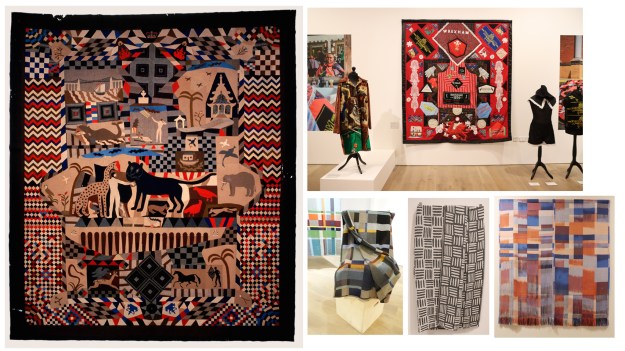
The Tailor’s Quilt measures 2.34m high by 2m wide (7.6 x 6.5ft) and contains over 4,525 pieces of material. It is far bigger than I was expecting, even knowing the measurements. It uses a fairly limited but perfectly harmonized palette of colours, drawn from what Williams had to hand. It shows scenes from the Bible such as Adam naming the animals, Noah’s Ark, Jonah and the whale (fabulously, with only the legs showing out of the whale’s mouth), and Cain and Abel, with the sky filled with lightning. It also features motifs symbolizing Wales (a leek), England (a rose), Scotland (a thistle), and Ireland (a shamrock). Giving the composite scene a really modern twist, the Menai Suspension Bridge and Cefn Viaduct (with a steam engine and two carriages passing over it) are also prominently featured. The significance of the Chinese pagoda seems to escape most commentators, but perhaps (speculating recklessly) it was inspired by Chinese ceramics, which had become mainstream in 19th century Britain at the time. Part of the fun of the piece, with a huge, self-satisfied black panther dominating the composition, is looking for the vignettes and enjoying the details in each one.

Image source: Tŷ Pawb website, with original image © Amgueddfa Cymru (National Museum Wales).
The combination of abstract, symbolic and representational takes time to absorb, and it works perfectly both on the level of the detailed vignettes and as a complex composition that instantly creates an attractive and appealing impression. It is difficult to imagine how, over a 10 year period, Williams was able to keep hold of the compositional elements to create something so beautifully balanced and proportioned. As the Tŷ Pawb website puts it, “The quilt is now widely regarded as one of the best surviving examples of Welsh folk art.”
It was exhibited at the Art Treasures Exhibition of North Wales in 1876 and the National Eisteddfod in 1933, both held in Wrexham, and in the British Empire Exhibition in Wembley in 1925. Although its travels were put on hold for conservation work, it is now fit for travel once again, and was displayed in the Victoria and Albert Museum’s Quilts 1700-2010 exhibition in 2010, and was loaned to the Wrexham Museum for a temporary exhibition in 2017. Its return to Wrexham at Tŷ Pawb in 2022 is very welcome.
Modern Responses to the Tailor’s Quilt
One of the reasons that this exhibition is so appealing is that it explores how The Tailor’s Quilt influenced and inspired other artists working in the same medium. It offers an opportunity not merely to see a sublime example of the genre, but to see how modern textile artists have incorporated design elements of the quilt in their own work.
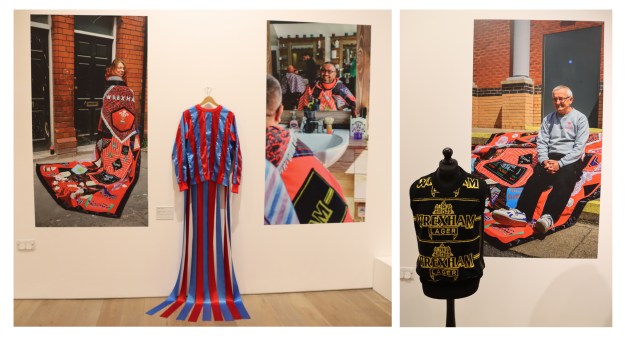
 The most original of the contributions is that made by fashion designer Adam Jones, who was commissioned by Tŷ Pawb to make a quilt of his own to be displayed adjacent to the Tailor’s Quilt. It works superbly, because Adam Jones has a style that is quite unlike that of James Williams. His bright, often garish clothes are attention-grabbing and regularly make use of clashing colours, textual elements and pub-themed motifs to make often loud, sometimes kitschy and frequently humorous statements. Adam Jones is from Froncysyllte near Wrexham, but is now based in London. Although there are garments from Adam’s collection in the exhibition, to demonstrate some of his creative range, his quilt is particularly interesting in this context. It combines the inspiration of the Tailor’s Quilt with a unique vision of Wrexham, its football team and pubs, and has its own intense personality. The composition is set against a bright, shiny red background (Wrexham FC’s dominant colour), and is full of references to Wrexham, and in particular Wrexham Lager. Contrasting textures, like lace and towelling, and everyday objects like a butcher’s apron and a pair of gloves are intertwined with abstract geometric shapes inspired by the Tailor’s Quilt. Instead of all four nations, Wales is given pride of place with the dragon at its base. Flanking Jones’s quilt are huge photographs of the quilt with local people, one man sitting on it, another draping it around her shoulders, removing textile art from the clean walls of the gallery and taking it back to its spiritual home. Great fun.
fasdfs
 Painter and printmaker Mark Herald was commissioned by Tate Britain to create some pieces based on the Tailor’s Quilt for the Tate’s shop. Mark’s sketchbook is displayed here, together with some of the items that he created for Tate Britain (some of which are currently for sale in the Wrexham Museum, a short walk away). His pieces include pictures, mugs, plates and bags. He takes motifs and themes from the Tailor’s Quilt, gives them a bright hit of colour, and arranges them in harmony on the new surfaces. They work superbly, echoing the Quilt, the motifs unmistakeably lifted from its progenitor, but given a bright, modern twist on the surface of everyday objects. Although none of his other works are shown in the exhibition, a quick web search shows why Tate Britain chose him. His own artworks are similarly full of light, often referencing the animal world, full of bright colours and dynamic shapes.

The name that pops up repeatedly when you do a search on the Tailor’s Quilt is clothes Sarah Burton, Creative Director of the fashion house Alexander McQueen. Sarah Burton was inspired by the Tailor’s Quilt on a visit to St Fagan’s Museum, and incorporated its themes into her Autumn/Winter 2020 collection.
 Her work provides yet another contrast. Just as the Tailor’s Quilt is the product of a professional tailor working in Wrexham, and Adam Jones’s quilt and clothing specifically reference the small town environment of the 70s and 80s that were part of his upbringing, Sarah Burton’s clothing is self-consciously aimed at the catwalk and is the product of the couture design world. Angular shapes and big panels of fabric are imprinted with motifs lifted directly from the Tailor’s Quilt, but given a new colour palette and an entirely new feel.
Four small pieces exhibited together are by Judy Fairless, Anne Gosling, Barbara Harrison and Helen Lloyd, who each made a piece as a response to the Tailor’s Quilt for the Llangollen Quiltfest in 2017.

From top left, clockwise: Ann Gosling “What a busy life I lead;” Helen Lloyd. “Jump,” Barbara Harrison, “The world around me,” and Judy Fairless, “All Stitched Up”
Although every exhibition has a curator and a team of skilled assistants, the general public does not often hear much about them. This exhibition was the brainchild of the late Ruth Caswell, to whom the exhibition is dedicated. She was a very remarkable and award-winning costumier, designer, artist and teacher, as well as a skilled curator of exhibitions, of which this was her last. The Tŷ Pawb website explains how she started out:
 Ruth moved to London in the 1960s, when she met and married her husband actor Eddie Caswell. Ruth said: “When we married and moved to London, we had only £12.50 to our name so I made clothes in my back bedroom and sold them in Kensington Market on a stall next to Freddie Mercury’s. I delivered them on the 73 bus each Friday and they sold instantly.” Ruth’s clothes were photographed for Vogue and worn by model Jean Shrimpton.
There is a video in the exhibition showing Ruth talking at fascinating length about textile design, and her enthusiasm, eloquence and generosity of spirit are very evident.
rewrwe
Final Comments
 Quilting and patchwork, as craft activities, have a long tradition in domestic contexts, either for daily use or to mark special occasions from the Medieval period onwards. The Tailor’s Quilt, imagined and hand-stitched by a professional tailor, was very much the product of a professional skill, but was also created within a domestic context. The exhibition makes it clear how craft activities are now gaining traction in the fields of design and textile arts, featuring on catwalks and in art galleries. The liminal position held by textile arts for at least a century, is slowly being eroded, and textile is coming of age in a number of commercial contexts where they are recognized as both design and art.
It was a particular stroke of genius to organize The Tailor’s Tale and Blanket Coverage at the same time, and provide them with a single space to share. Whilst quite different in their content and their style of display, both raise questions about how textiles are regarded today, and what they bring to the world of art. Both of the exhibitions, the one exploring the impact of a single magnificent piece (the patchwork quilt) and the other exploring the multiple facets of a single genre (blanket weaving), work beautifully both in isolation and together.
With this new exhibition, the Tŷ Pawb gallery has again provided the perfect venue for bringing together modern art and local history, whilst also exploring more universal themes. The exhibitions The Tailor’s Tale and Blanket Coverage run at Tŷ Pawb until September 24th 2022 between 10am and 4pm Monday to Saturday. Entry is free of charge.
Sources:
Books and papers
 Jones, J. 2016. Welsh Quilts. Seren
Rose, C. 2011. A patchwork panel ‘shown at the Great Exhibition. V&A Online Journal, Issue No. 3 Spring 2011
http://www.vam.ac.uk/content/journals/research-journal/issue-03/a-patchwork-panel-shown-at-the-great-exhibition/#:~:text=This%20technique%2C%20also%20known%20as,allowances%20and%20no%20backing%20fabric.
Ty Pawb handouts, 2022.
– Artist Biographies
– Ruth Caswell
Websites
175 Heroes
Ruth Caswell
https://175heroes.bradfordcollege.ac.uk/ruth_caswell.html
Build Hollywood
Your Space or Mine: Adam Jones
https://www.buildhollywood.co.uk/work/adam-jones/
National Museum of Wales
Patchwork Bedcover
https://museum.wales/collections/online/object/4ce80b8d-182e-3822-8038-54080af6b0b8/Patchwork-bedcover/
Tŷ Pawb
https://www.typawb.wales
The Tailor’s Tale / Blanket Coverage at Tŷ Pawb 02/07/22 – 24/09/22
https://www.typawb.wales/exhibitions/the-tailors-tale-blanket-coverage/
Based in Churton
Exhibition write-up: The luxuriant “Blanket Coverage” at Tŷ Pawb gallery, Wrexham. By Andie Byrnes
https://wp.me/pcZwQK-2F8
 Based in Churton
Interesting piece. But James Williams of Tailor’s Coverlet fame is never shown on any of the relevant Census records as having his premises anywhere but initially on Pen-y-Bryn but then for the rest of his career at 8 College Street. Unlikely, as well, that the J.Williams in Church Street would have been the same man. Our James Williams made his name from early in his career as a Master Military Tailor – not a draper. The St. Fagans Museum have verified that much of the “quilt” is probably fashioned from parts of old military uniforms. Always interesting to chat with Elen Phillips at the Museum about all this.
LikeLiked by 1 person
Always good to have ambiguities resolved. Thanks very much.
LikeLiked by 1 person
I’ve also just seen that the Wrexham History Group date this photo to the 1860s, when James Williams was most definitely in College Street. However, Palmer also talks about John Williams and his family, prominent drapers of the town, involved in the building of a new Methodist chapel in Salop Road. More likely this family in Church Street, maybe.
LikeLike